
The same premises can fall under residential use according to the Building Code, a different purpose according to the local urban planning plan, and a mixed use according to the condominium regulations. These three qualifications do not always overlap, and it is precisely this discrepancy that generates disputes during a sale, rental, or transformation. Understanding what the notions of use and purpose entail allows for anticipating administrative procedures and avoiding costly regularizations.
Use and purpose of a premises: table of legal differences
The two concepts are governed by distinct codes and do not involve the same procedures. Confusing one with the other exposes one to different sanctions.
| Criterion | Use (Building and Housing Code) | Purpose (Urban Planning Code) |
|---|---|---|
| Reference text | Article L.631-7 of the CCH | Articles R.151-27 and R.151-28 of the Urban Planning Code |
| What is qualified | The actual use of the premises (residential or other) | The function for which the building was constructed or authorized |
| Geographical scope | Communes with more than 200,000 inhabitants and tense areas | The entire national territory |
| Nature of the authorization | Personal and temporary authorization (unless compensated) | Prior declaration or building permit |
| Character | Attached to the person of the applicant | Attached to the property, definitive |
A premises can therefore have a “residential” purpose in urban planning while having lost its residential use according to the CCH, for example after years of unregulated commercial exploitation. The reverse also exists: a premises classified as “commercial” in the PLU but occupied as housing for several decades may be deemed for residential use.
To delve into the subtleties between these qualifications, you can learn more on Flash Immobilier which details the applicable distinguishing criteria.
Check the legal history of a premises before purchase: archives and tax files
Competitors detail the procedures for changing use or purpose. Few explain how to reconstruct the history of a premises before signing a preliminary agreement. Yet this verification determines the feasibility of a project.
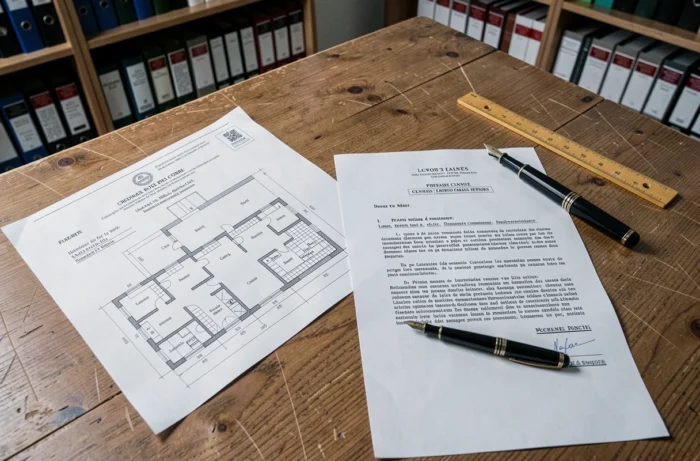
Cross-reference cadastral archives and the H2 tax file
The H2 file (or H1 for a house) is the document filled out by the owner during construction or the last tax declaration. It mentions the nature of the premises: residential, commercial, mixed use. This file is accessible at the land publicity service or directly at the property tax center.
The cadastre provides information on the category of the property (residential premises, commercial premises, outbuilding). A discrepancy between the tax file and the cadastre often signals an undeclared change.
The law of November 19, 2024 expands the proof of residential use
Before this law, proof of residential use relied almost exclusively on the status of the premises as of January 1, 1970. Now, a premises can be deemed for residential use if it was allocated to this use between 1970 and 1976, or at any time during the thirty years preceding the request for authorization or the dispute. This expanded window changes the game for many Parisian premises whose qualification seemed fixed.
The burden of proof lies with the one alleging illegal use, and it can be established by any means: old leases, neighbor attestations, charge statements, energy bills. A savvy buyer therefore has an interest in gathering these documents before signing rather than discovering the issue during a municipal inspection.
Change of purpose without work: authorization remains necessary
The idea that the absence of work exempts from urban planning formalities is common. However, the Court of Cassation dismissed it on September 3, 2024: a change of purpose may require authorization even without work. Transforming a commercial premises into housing (or vice versa) without prior declaration exposes one to an infringement report and a restoration ordered by the court.
The type of authorization depends on the change being considered and the PLU zone. The most common cases:
- Changing from “commercial” to “residential” without modifying the load-bearing structure or the façade: a prior declaration is generally sufficient.
- Changing from “residential” to “hotel accommodation” (furnished tourist rental) in a commune subject to authorization for change of use: both a prior declaration in urban planning and the mayor’s authorization under the CCH are required.
- Modifying the façade or creating additional floor area during the change of purpose: a building permit becomes mandatory.
Condominium and tourist rental: what the law of November 19, 2024 changes
The condominium regulations constitute a third filter, distinct from urban planning and the CCH. The law of November 19, 2024 has strengthened the power of general assemblies regarding furnished tourist rentals.
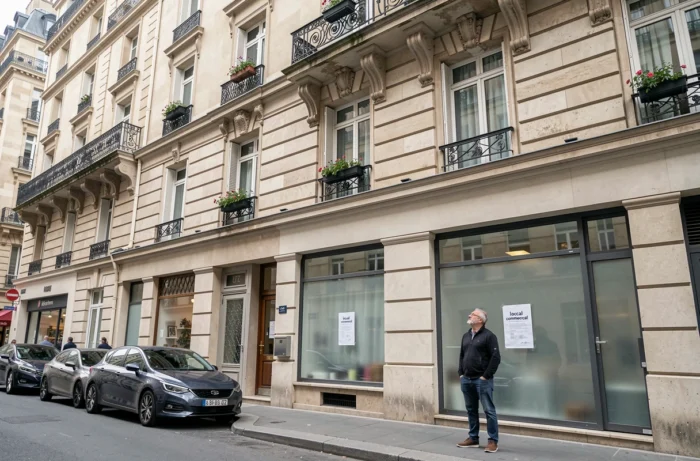
Under certain conditions, the general assembly can prohibit the furnished tourist rental of residential lots that are not primary residences. The condominium regulations established since the law came into force must explicitly state whether this rental is authorized or prohibited.
For a buyer, this means that it is no longer sufficient to check the use and purpose of the premises with the town hall. It is also necessary to read the updated condominium regulations and consult recent general assembly minutes to know if a vote has restricted short-term rental possibilities.
- Request the current condominium regulations and any amendments voted after November 2024 from the property manager.
- Check if the targeted lot is classified as “exclusive bourgeois housing” (prohibition of professional activity) or “bourgeois housing” (tolerance of liberal activities).
- Consult the general assembly minutes to identify any resolutions restricting seasonal rentals.
A premises classified as an apartment in the sales deed, authorized for residential use by the PLU, and compliant with the CCH, may still be unusable for tourist rental due to the condominium regulations. This last filter is the one that buyers most often overlook, and it generates the most disputes since the reform.