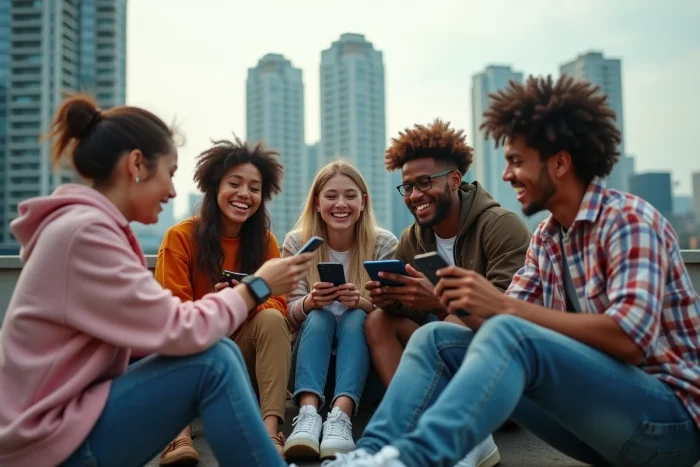
A video takes off with millions of views even as night falls upon it, without the slightest advertising push. A challenge invented by a pseudo-unknown crosses continents faster than airlines. Misinformation sometimes stands up to official news and garners three times more shares, even against armies of digital moderators. Between Paris and Seoul, whether in a lost village or a metropolis, micro-events rise to the top of trends. An anecdotal post sparks global discussions. Behind this, algorithms, far from the neutrality they claim, act as conductors and reshape what tomorrow’s buzz will be.
What unusual trends reveal about our connected society
These unusual trends rising on social networks are no longer mere amusements. They become a reflection of a connected society that resonates with videos and anecdotes emerging from the shadows. Not a day goes by without a photo or a video creating surprise, driven by anonymous individuals or groups dedicated to unbridled creativity. On Instagram or TikTok, the game has changed: it’s all about total spontaneity, rapid shared bursts, and a collective ability to seize anything that breaks the digital routine.
The rhythm of social networks imprints new reflexes. Everyone dives in, diverts, or remixes content that no one would have noticed ten years ago. Here, followers keep time zones at bay but unite around the same winks. Virality is no longer an exception: it’s a mechanism that continuously redefines usage, modes of expression, and references of web social networks. In summary, the brilliance of improbable content ends up marking discussions, shaking up habits and generations.
It’s impossible not to see the influence of those who watch and sense what is about to make history. News enthusiasts and the curious scour the news on Actu Buzz, trying to guess which content will make headlines on the web. This constant decoding, immersed in the daily flow of images and buzz, shows the agility with which internet users spot, share, or reinvent the meaning of the collective, turning the unusual into a new shared usage.
What news and current events are buzzing in France and around the world today?
Publishing a news item today is like igniting a spark on gunpowder. A simple phrase, a video, and suddenly Paris, Toulouse, or Biarritz vibrate around an unusual fact. The echo is immediate, global. The event leaves the local circle to spread across the internet buzz with an unprecedented amplifying effect.
We see news items paraded like media figures: Justin Trudeau, Emmanuel Macron, Donald Trump, every gesture, every phrase, everything is picked up, mocked, diverted by community managers and internet users who have become prodigies of virality. Serious issues, the conflict in Ukraine, war in the Middle East, diplomatic tensions, mingle with the buzz, blurring the line between hot information and mass phenomenon.
Simple stories become the cement of virality. Thus, Caroline Estremo, a nurse whose words crossed borders in just a few days, or those explosive horse races everyone is talking about. The millions of views accumulate, sometimes on unexpected subjects: a meme about Mariah Carey, the release of a Harry Potter episode, a contest at Ikea, the latest announcement from SpaceX. At the first opportunity, these massive communities get excited, share, and reshape the narrative.
It’s impossible to isolate France. Here too, the playground is vast. A YouTuber never seen before shatters records, an inventive escape game draws crowds in Toulouse, a jackpot of millions of euros lifts all of Paris. Now, nothing is reserved for Paris or celebrities. Virality imposes itself everywhere: in a lost neighborhood or a big city, the slightest info can suddenly shift into global light, carried by the energy of internet users.

When the viral shapes our behaviors: understanding the impact of online phenomena
What circulates online ultimately leaves its mark on our attitudes. On Instagram, TikTok, or elsewhere, the slightest video can shape a new reflex. A challenge, a meme, and an entire segment of youth appropriates the movement. Viral phenomena even disrupt how we dress, how we speak, how we share a laugh.
A true open-air laboratory, each social network becomes the place where the collective is experimented upon. Influencers show a path that goes far beyond product placement. They influence culture, consumption habits, humor, language. Followers, consumers of news but never passive, contribute to mutating buzz until they overturn a phenomenon that has become too heavy or too omnipresent.
No boundary holds for long: the enthusiasm born from a shared image, from an offbeat video, now shapes how we create connections or collectively appropriate a topic. It remains to be seen what the next rituals will be, what new absurdity will trigger this strange and swift wave of unity. It’s impossible to predict what the cycle of virality will prepare for tomorrow, nor which small event will further transform our most everyday usages.