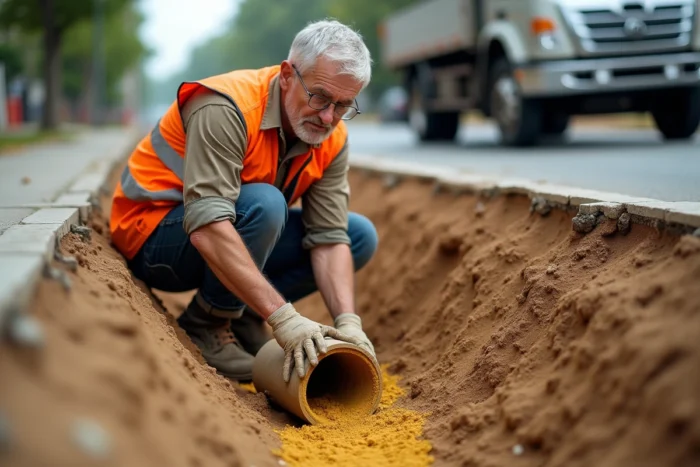
Installing an underground pipeline without suitable backfill material exposes the pipe to deformation, puncturing, and differential settlement. Sand, used as a bedding layer and protective envelope, serves a precise mechanical function: distributing the loads from the soil and surface traffic around the entire perimeter of the pipe. Its grain size, cleanliness, and method of implementation directly affect the lifespan of the network.
Compatibility between backfill sand and pipe material
Competitors often treat sand as a generic product. The technical reality is more nuanced: the choice of backfill material depends on the type of pipe installed.
A flexible PVC pipe, with moderate ring stiffness, poorly tolerates hard points. The slightest angular stone concentrates pressure on a small area of the wall and can cause localized puncturing. A fine, well-graded sand is therefore the best defense.
Conversely, a GRP (glass-reinforced plastic) or cast iron pipe has higher ring stiffness. It better withstands point loads but remains sensitive to ovalization if lateral support is insufficient. To understand how sand for pipelines works in this configuration, one must consider the backfill as a complete system, not just a simple bottom layer.
High-density polyethylene (HDPE) pipes, used for drinking water, add an additional constraint: their flexibility requires careful lateral compaction to maintain the circular section under load. Sand alone is not sufficient if the implementation is sloppy.
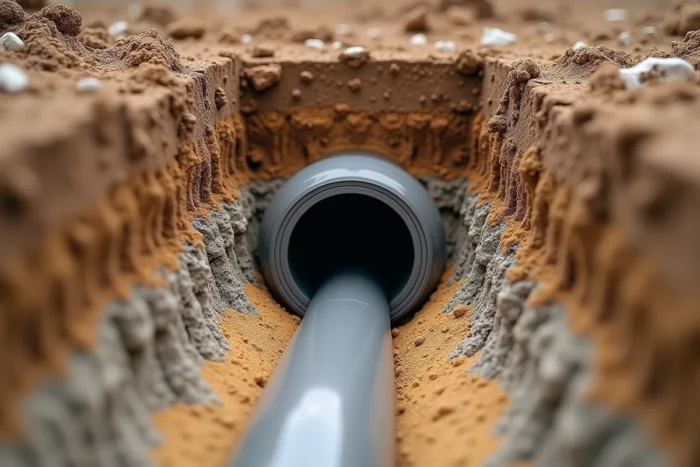
Grain size of bedding sand: 0/4 or 0/6, and why it changes everything
Two grain sizes dominate the civil engineering sites: 0/4 mm sand and 0/6 mm sand. The former offers a finer texture, thus providing a more uniform contact with the pipe wall. The latter, slightly coarser, compacts more easily and drains runoff water better in the trench.
Selection criteria based on the network
- For a gravity sewer network, 0/4 mm sand provides a regular backfill that limits the risk of deformation under the permanent load of the backfill.
- For a stormwater network with variable flows, 0/6 mm sand facilitates drainage around the pipe and reduces temporary hydrostatic overpressures.
- For a drinking water supply, the sand must be free of organic matter and fine clay particles, regardless of the chosen grain size, to avoid contamination from particle migration.
Topsoil should be avoided in all cases. Its organic decomposition creates voids under the pipeline, causing differential settlements that weaken the joints.
River sand or quarry sand
River sand, with rolled and rounded grains, offers good fluidity during lateral filling. Quarry sand, with more angular grains, compacts more and better withstands vertical loads. On a site where mechanical compaction is possible, quarry sand generally yields better long-term stability results.
Implementation of the bedding layer and backfill: technical steps
Sand is involved at three levels in the trench: the bedding layer (under the pipe), lateral support (the “haunches”), and the upper cover (above the top of the pipe). Each layer serves a distinct mechanical role.
Preparation of the excavation bottom
The bottom of the trench must be leveled to a uniform height, free of blocks or roots. If the natural ground contains rocky elements, over-excavation followed by filling with compacted sand is necessary. The thickness of the bedding layer varies according to the diameter of the pipe, but the principle remains constant: ensure continuous support along the entire length.
Lateral support and layer-by-layer compaction
The support of the pipe haunches is the most critical step. Poorly compacted filling in this area allows the pipe to deform under the load of the backfill. The sand must be placed in successive layers, each compacted mechanically or by manual tamping depending on the width of the trench.
The moisture content of the sand plays a crucial role. Sand that is too dry does not compact properly: the grains slide without interlocking. Over-saturated sand loses its cohesion and exerts uncontrolled lateral pressure on the pipe. The goal is to achieve the Optimum Proctor, which is the moisture content that maximizes the density of the material after compaction.

Upper cover before general backfill
A layer of sand above the top of the pipe protects the pipeline from point loads transmitted by the trench backfill. This layer acts as a buffer between the general backfill materials and the pipe wall.
Concrete risks of poorly executed backfill
Poorly chosen or improperly placed sand does not just reduce the lifespan of the network. The consequences sometimes appear years after installation.
- The progressive ovalization of the pipe reduces the flow section and promotes deposits, accelerating the blockage of the wastewater network.
- A joint that is stressed due to differential settlement eventually loses its tightness, allowing the infiltration of unwanted water or contamination of the surrounding soil.
- In a drinking water pipeline, an undetected loss of tightness leads to continuous waste and a health risk if pollutants migrate into the network.
The majority of incidents in buried networks stem from implementation, not from the pipe material itself. The choice of sand and the rigor of compaction constitute the first line of defense against these disorders.
A well-encased network in sand suitable for the nature of the soil and the type of pipe can operate for decades without intervention. In contrast, a site where lateral compaction has been neglected, where the grain size of the sand has not been checked, or where the moisture content has not been controlled generates costly repairs on sections that are sometimes difficult to access.