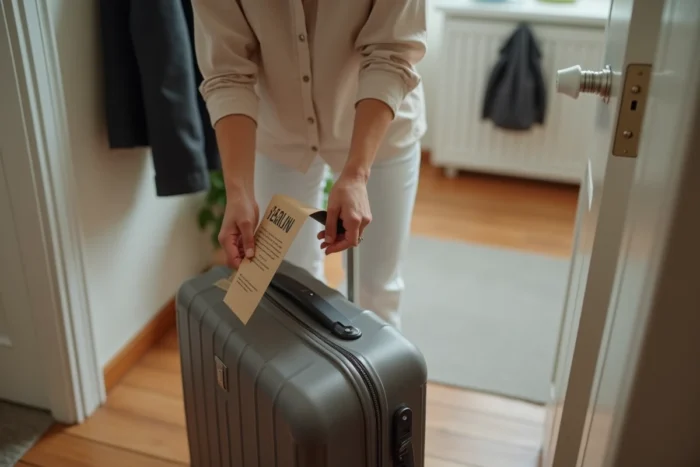
Labeling luggage for trains and planes follows different logics: regulatory obligations, required information, format of the support. Comparing these two worlds allows for choosing the right template before printing anything, and avoiding an unusable label on the day of departure.
Train or plane luggage label: requirements table by transport
Rail and air companies do not require the same data on a label. Here’s what concretely distinguishes the two formats.
| Criterion | SNCF (TGV, TER, Intercités) | Plane (checked baggage) |
|---|---|---|
| Legal obligation | Yes, labeling is mandatory on TGV, TER, Intercités, and some suburban trains | Yes, label attached at the check-in counter |
| Minimum information | First name, last name, contact details (or anonymized QR code) | Name, destination, flight number (generated by the airline) |
| Who provides the label | The traveler (printing at home, at the station, or on board) | The airline at the check-in counter |
| Cost | Free | Free (included in the check-in) |
| Penalty for absence | Fine between 150 and 750 euros | Refusal to board checked baggage |
| Data protection | Anonymized QR code available from 2024-2025 | Barcode linked to the sorting system, no visible data |
This table shows a major gap: by train, it is the traveler who prepares and attaches their label. By plane, the airline takes care of it at check-in. The issue of printing at home mainly concerns rail travel, although some travelers prefer to supplement the airline label with a personal model on their cabin baggage.
Downloading a printable luggage label for SNCF in PDF format remains the most reliable method to leave with a template of the correct dimensions, ready to be cut and attached.
Fine for unlabelled SNCF baggage: what the new law provides
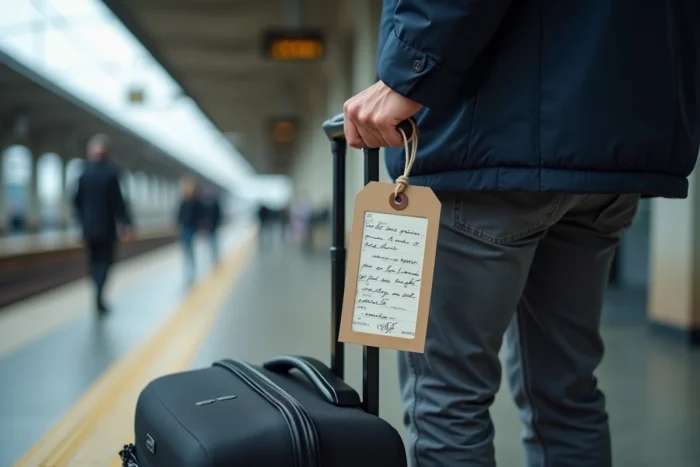
Most articles on labeling simply remind that it is mandatory. Few detail the actual financial consequences. Since the new law came into effect, an unlabelled bag on a train can cost between 150 and 750 euros in fines.
This amount does not apply only to TGVs. TER, Intercités, and some suburban trains are also affected. The absence of a label becomes a central criterion for qualifying the offense when a bag is found abandoned or forgotten.
SNCF has made the label (with contact details or anonymized QR code) a safety element, not just a travel recommendation. An unidentifiable bag in a rail space can trigger a security procedure that delays all traffic.
Anonymized QR code: protecting personal data
Displaying name, address, and phone number on a label in plain text poses an obvious privacy issue. From 2024-2025, SNCF will provide free paper labels incorporating a QR code linked to the traveler’s contact details. Agents scan the code to identify the owner, but no personal data is visible to the naked eye.
These labels are available at the station and on board. For those printing at home, the online e-Tiquette service generates a template compatible with this system.
PDF template for plane and train luggage: criteria for a reliable printable document
A PDF file downloaded randomly from a search engine offers no guarantee of compatibility. Several technical criteria determine whether a printed label will hold up during travel.
- The format must correspond to a readable size after cutting, generally close to a business card or slightly larger, to remain attached to the handle or strap without bending
- The paper weight matters: paper that is too thin tears at the first friction in the hold or on the luggage rack, adhesive or laminated paper holds up significantly better
- The fields must include at least first name, last name, and a means of contact (phone or email), with space for the QR code if the template is intended for SNCF
- The layout must allow printing on any home printer, without cropping or loss of information at the edges
A well-designed template works equally well for both train and cabin baggage on a plane. The difference lies in the filled fields, not the physical support. For checked baggage, the personal label serves as a supplement to the airline’s tag, not a replacement.
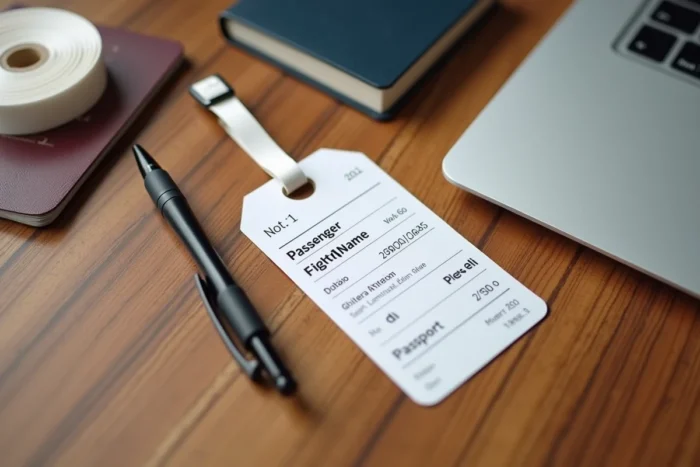
Attaching the label to the suitcase: common mistakes to avoid
Printing a correct template is not enough if the attachment is sloppy. Three mistakes occur regularly.
- Sliding the label into the outer pocket of the suitcase without securing it: it falls off at the first movement on the luggage rack or conveyor belt
- Using standard tape that peels off with moisture or heat in the hold, making the label unreadable upon arrival
- Filling out the label with erasable pen or non-permanent marker: the information becomes unreadable after a few hours of friction
The most reliable method remains to laminate the printed label (even with a simple cold laminating pouch) and then secure it with a tie passed through the handle. For hard suitcases without an integrated tag holder, a laminated sticker directly adhered to the shell holds up better than a loose cardboard.
Recommended duplicate for long journeys
Placing a second label inside the suitcase (in the main pocket, visible when opened) allows for locating the owner even if the outer label has disappeared. This reflex is particularly useful for train-plane connections where the baggage changes hands multiple times.
Labeling a suitcase takes only a few minutes before departure. The PDF template, a printer, a permanent marker, and a sturdy attachment tie are all that is needed. The extra cost is negligible, the protection against loss or fines is real, and the anonymized QR code addresses the privacy issue that has previously held back some travelers.