Stellantis brings together fourteen automotive brands spread across Europe and North America. Measuring the trajectory of this group, born in 2021 from the merger between PSA and FCA, requires looking at three indicators in parallel: the shift to electric production on new platforms, the management of a large brand portfolio, and the repositioning on software revenues. These three axes outline an industrial profile in tension between technological ambition and financial rationalization.
STLA Large Platform: Transition to Industrial Production
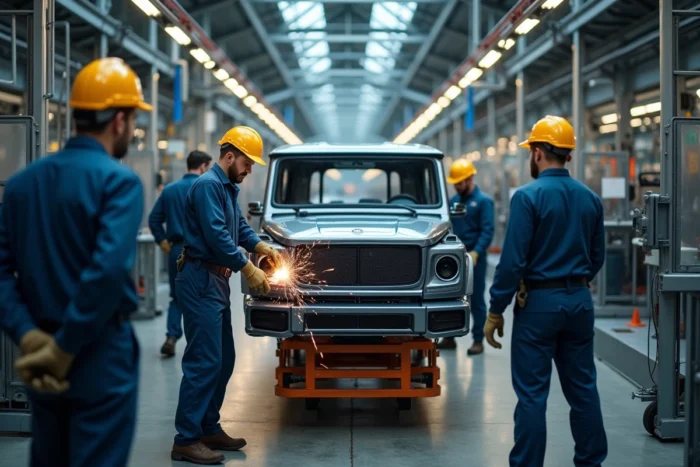
Most manufacturers communicate about their future electric architectures. Stellantis has taken a concrete step with the launch of the STLA Large platform into production at its Windsor plant in Ontario. This technical base is intended for large electric SUVs and pick-ups for the North American market, a segment where demand remains strong despite the global slowdown in electric vehicle sales.
The ramp-up of this production line constitutes a real-world test. As detailed on the Stellantis wiki on Wiki FR, the group relies on several modular platforms (STLA Small, Medium, Large, and Frame) to cover all its segments. STLA Large is the first to reach the stage of serial production, allowing for an assessment of the group’s actual capacity to turn its announcements into volumes.

Stellantis Brand Portfolio: Focus on Four Pillars
Stellantis operates fourteen brands, from Peugeot to Maserati, including Jeep, Ram, Citroën, and Alfa Romeo. According to information reported by Reuters and echoed by La Tribune, the group intends to concentrate the majority of its investments on Peugeot, Fiat, Jeep, and Ram. This refocusing reflects a logic of profitability by volume rather than a scattergun approach to niche brands.
The table below summarizes the positioning of the four priority brands relative to the other brands in the portfolio:
| Priority Brand | Main Market | Key Segment |
|---|---|---|
| Peugeot | Europe | Compact cars and SUVs |
| Fiat | Europe, South America | City cars and utilities |
| Jeep | North America, global | Off-road SUVs |
| Ram | North America | Pick-ups |
In Italy, the future of brands like Abarth, Lancia, and Maserati remains uncertain. These brands have a strong identity but limited volumes. The question posed by the group’s management is simple: each brand must prove its regional economic viability, otherwise adjustments are being considered.
What This Refocusing Means for Europe
Peugeot and Fiat absorb the bulk of the European industrial effort. Peugeot benefits from a dense commercial network in France and an already engaged electrified range. Fiat, on its part, targets entry-level volumes in a continent where competition from Chinese manufacturers is intensifying in the small electric vehicle segment.
In contrast, Jeep and Ram focus their investments on North America, where unit margins are higher in the SUV and pick-up segments. This geographical distribution creates two distinct industrial logics within the same group.
Stellantis Software Revenues: From Internal Projects to Targeted Partnerships
In 2021, Stellantis expressed the ambition to generate several tens of billions of euros in software revenues by 2030, by massively developing solutions in-house. This trajectory has been revised between 2025 and 2026 in favor of a mixed approach.
The group is now betting on targeted partnerships, notably with Amazon for cloud services and embedded connectivity. The integration of open-source software into onboard computers partially replaces proprietary development. This shift deserves to be put into perspective:
- Internal software development mobilized considerable resources without a guarantee of quick returns, in a sector where update cycles are short
- The partnership with Amazon allows access to an already scaled cloud infrastructure, reducing fixed costs related to data centers and vehicle data processing
- The adoption of open-source components facilitates standardization across STLA platforms, instead of multiplying proprietary systems by brand
This repositioning reflects a pragmatic compromise. The ambition of a “software-defined” car manufacturer faces the reality of development costs and the execution speed of already established tech giants.

Automotive Production and Energy Transition: Ongoing Trade-offs
Stellantis has ended certain programs deemed unprofitable, such as hydrogen for light mobility. This choice illustrates a clear prioritization: battery electric remains the main vector of the group’s energy transition at the expense of alternative solutions that are still far from industrial maturity.
Production in France and Italy is under discussion with their respective governments. The volumes produced in Europe directly depend on the demand for electric models, which is progressing but remains below the initial forecasts of several manufacturers.
Chinese Competition in the European Market
Chinese players are offering electric vehicles at aggressive prices in the entry and mid-range segments. Stellantis responds with two levers: repositioned Fiat and Citroën models in price, and a premium offering on Peugeot to defend margins.
The group is thus trying to bridge the gap between accessible vehicles and higher value-added models. The ability to maintain this dual strategy will depend on the speed of reducing battery production costs and the evolution of European emissions regulations.
The journey of Stellantis can be read through a structuring indicator: the share of each brand in the consolidated results. While Peugeot, Fiat, Jeep, and Ram concentrate investments, the actual profitability of each will determine the group’s shape by the end of the decade. The coming quarters will reveal whether the ramp-up of STLA Large and the software partnerships yield tangible results.