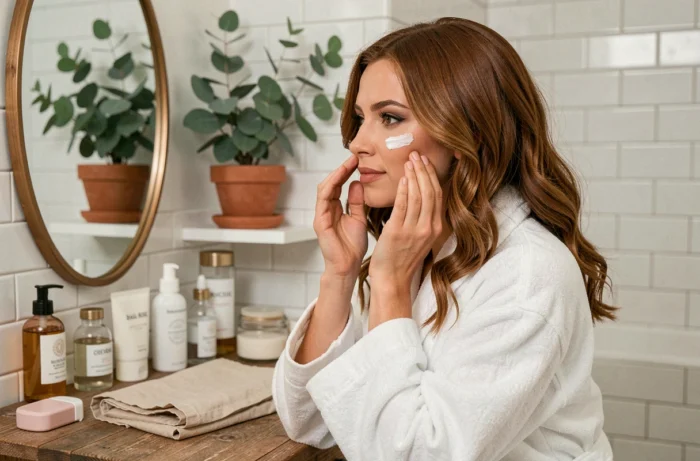
The European cosmetics market operates within a regulatory framework that requires every product to undergo a safety assessment before being placed on the market. European regulations require cosmetics to be safe under normal or reasonably foreseeable conditions of use, with independent scientific input from the SCCS for substances of concern.
Between this legal requirement, claims printed on packaging and voluntary labels such as the EU Ecolabel, the distinction remains unclear for anyone who simply wants to care for their skin every day.
Beauty routine and sensitive skin: what the regulations actually say
When a cosmetic product is sold in the European Union, its safety has been assessed in advance. The European Commission relies on the SCCS (Scientific Committee on Consumer Safety) to review substances that raise concerns. This committee publishes independent scientific opinions, and its work on cosmetic ingredients is ongoing.
For sensitive skin, this distinction matters. A product that complies with regulations is not automatically formulated to limit skin reactions. It is simply considered safe for normal use. Most consumers miss the distinction between “safe” and “suitable for reactive skin.”
The EU Ecolabel goes further on one specific point: it sets specific limits for certain fragrance allergens in certified cosmetics, with stricter requirements for products intended for sensitive skin. These limits apply to both rinse-off and leave-on products. Looking for this label on a bottle provides a concrete indication, even though the Ecolabel does not cover all the requirements applicable to cosmetics.
The sections on beauty on Les Carnets de Mademoiselle offer a closer look at the differences between labels, marketing claims and genuine formulation guarantees.

EU Ecolabel, “hypoallergenic” claims and marketing promises: how to read a cosmetics label
The word “hypoallergenic” on packaging has no strict regulatory definition in the European Union. A manufacturer can use it if they believe their product has a low potential to cause allergic reactions. No mandatory standardized test is required for the term to be used.
The EU Ecolabel works differently. Its criteria are published in an official document and verified by an independent third party. For Ecolabel-certified cosmetics, requirements cover the presence of certain fragrance allergens, with measurable limits. An Ecolabel-certified product meets criteria that can be verified by a third party, setting it apart from a simple marketing claim.
Here are the details to look for on a label to make an informed choice:
- The INCI list (International Nomenclature of Cosmetic Ingredients), which is mandatory, lists ingredients in descending order of concentration. Declared allergens appear at the end of the list when present above the regulatory threshold.
- The EU Ecolabel logo (the little flower) identifies a product that meets verified environmental and health criteria, including requirements for fragrance allergens.
- Claims such as “fragrance-free” or “alcohol-free” are voluntary statements made by the manufacturer. They are not systematically subject to independent checks before the product goes on sale.
Reading a label takes thirty seconds. Checking the INCI list and looking for an Ecolabel provides more information than any advertising slogan.
Daily sensitive-skin routine: the steps that really matter
Using more products does not offer better protection for reactive skin. A minimalist routine limits potential sources of irritation. In most cases, three steps are enough: cleanse, moisturize and protect from the sun.
Cleansing deserves particular attention. Harsh surfactants (especially sulfates listed near the top of the INCI list) weaken the skin barrier. A gentle cleanser with no added fragrance, used once or twice a day, helps preserve the skin’s natural hydrolipid film.
Next comes moisturizing. For sensitive skin, shorter formulas (with fewer ingredients) reduce the risk of a reaction. Fewer ingredients mean fewer potential allergens. A moisturizer with a simple base (glycerin, hyaluronic acid) does the job without overloading the skin.

Sun protection is the most overlooked step in a daily beauty routine. UV rays accelerate skin aging and can worsen sensitivity. A mineral sunscreen is often better suited to reactive skin than chemical filters, which can cause stinging.
What a minimalist routine cannot fix
A suitable skincare routine can improve skin comfort and natural radiance. It does not replace advice from a dermatologist in cases of persistent redness, eczema or rosacea. Available data on cosmetics concerns their safety in use, not their therapeutic effectiveness. This limitation is built into the regulatory framework itself: a cosmetic is not a medicine.
Regulatory simplification underway: what could change for consumers
European regulations on chemicals and cosmetics are currently undergoing a simplification process. The stated goals include making manufacturers’ obligations easier to understand and, ultimately, providing consumers with clearer information.
The precise details of this simplification are still under discussion. The implementation date for each change has not yet been confirmed for all the measures raised in institutional discussions. For consumers, this means that current points of reference (the INCI list, the Ecolabel and SCCS opinions) remain reliable in the short term.
The SCCS also continues its scientific assessments of cosmetic ingredients. Its working group meetings inform future regulatory revisions, although the conclusions of each session are not always made public immediately.
Taking care of your skin every day does not require a dozen products or a chemistry degree. Looking for the EU Ecolabel where available, reading the first five ingredients on the INCI list and sticking to a short routine suited to your skin cover the essentials. The European regulatory framework provides a baseline level of safety. Beyond that, it comes down to personal choice, guided by observing your own skin rather than by promises on a package.